
There is a particular kind of frustration that comes from watching a company fail while doing everything right. The targets get hit. The board is satisfied. The press release goes out on time. And yet something essential — some animating purpose, some human thing — quietly drains away. Eugene Theodore has spent the better part of two decades watching this happen in boardrooms, pitch decks, and turnaround engagements across industries. His response, eventually, was fiction.
Built to Collapse is a business novel — a form he chose with intention. “The polite answer is that the world does not need another leadership framework, model, acronym, or promise of optimisation,” he says. “It does need a story. One that when you read about situations you find all too familiar, brought to life by characters you recognize all too well, can bypass ingrained resistance and create the chance for change.”
He’s watched the alternative play out too many times. “I have met countless CEOs who overhauled entire organizations because they read a new business book on a flight — and misunderstood it,” he says. Story, in his view, is harder to misread. “The fiction is easier to understand and much less open to interpretation.”
“The mission turns into a transaction engine. By the time collapse becomes visible, the incentives have already done their work.”
The book’s central argument is uncomfortable in its specificity: companies don’t collapse because of bad leadership. They collapse because of capable leadership executing faithfully on a broken system. “Most companies don’t fail because their leaders are incompetent,” Theodore says. “Quite the opposite. Their leaders are capable, ambitious, and often admired for executing the modern business playbook flawlessly. That’s the irony.”
The playbook, as he maps it, is internally coherent and ultimately self-defeating. Value is delivered through velocity. Growth is the only metric that matters. Long-term durability becomes, in his words, “the next board’s problem.” And the original mission — the specific human problem the company was built to solve — quietly disappears.
“The mission turns into a transaction engine,” he says. “By the time collapse becomes visible, the incentives have already done their work. But the leadership can honestly say, ‘We did exactly what was expected.’ And that’s precisely the problem.”
When he talks about hidden risk, he isn’t pointing at the obvious places. He’s pointing at the gaps between tenures — the accumulated costs that don’t appear on any dashboard because they were created slowly, politely, across multiple leadership cycles, and assigned to no one in particular.
He offers three portraits. A succession of CMOs who trim Q4 advertising year after year to hit profit targets — each decision rational in isolation, each quarter closing strong. “Eventually, the next CMO inherits a brand that has faded in memory and must spend twice as much to rebuild what was quietly abandoned.” CTOs who defer infrastructure upgrades to protect margins until an incoming leader discovers “a fragile architecture held together by patches and technical debt that makes innovation nearly impossible, dooming any business future.”
CEOs who pursue acquisitions to sustain growth momentum until the final CEO in the line “inherits a portfolio so bloated and culturally fragmented that integration becomes a permanent state of chaos.”
“Hidden risk is rarely dramatic. It accumulates politely… and it is almost always discovered by someone else.”
The pattern repeats across sectors and scales because the underlying incentive structure is consistent. Theodore draws on experience with Fortune 500 companies, VC and PE firms, startup scouts, incubator programs, and turnaround specialists — environments that each see a different piece of the machine. “The boardroom sees one thing. The VC sees another. The founder sees something else entirely,” he says. “Individually, they look rational and admirable. But when you step back to review the larger system of incentives all these cogs build, that’s when it becomes harder to dismiss that what you’re seeing is a coincidence.”
His answer to this system is what he calls Community Capitalism — a term he explains through metaphor rather than manifesto.
Most companies, he argues, operate like mining operations: enter a territory, extract as much value as possible, move on, leave someone else to deal with what remains. “Community Capitalism is closer to tending a village well,” he says. “You draw from it, yes, but you also protect and maintain it. You make sure it will still serve the next generation. If the water stales, you don’t rebrand the bucket. You fix the source and everything around that touches it.”
The practical application is structural. It means building a company around the specific group of people whose problem it exists to solve — and treating their well-being as the primary performance indicator. He’s careful to distinguish this from the ESG-adjacent language that gets appended to annual reports. “They are your core, your raison d’être,” he says. “If they are stronger because you exist, your company will be too.”
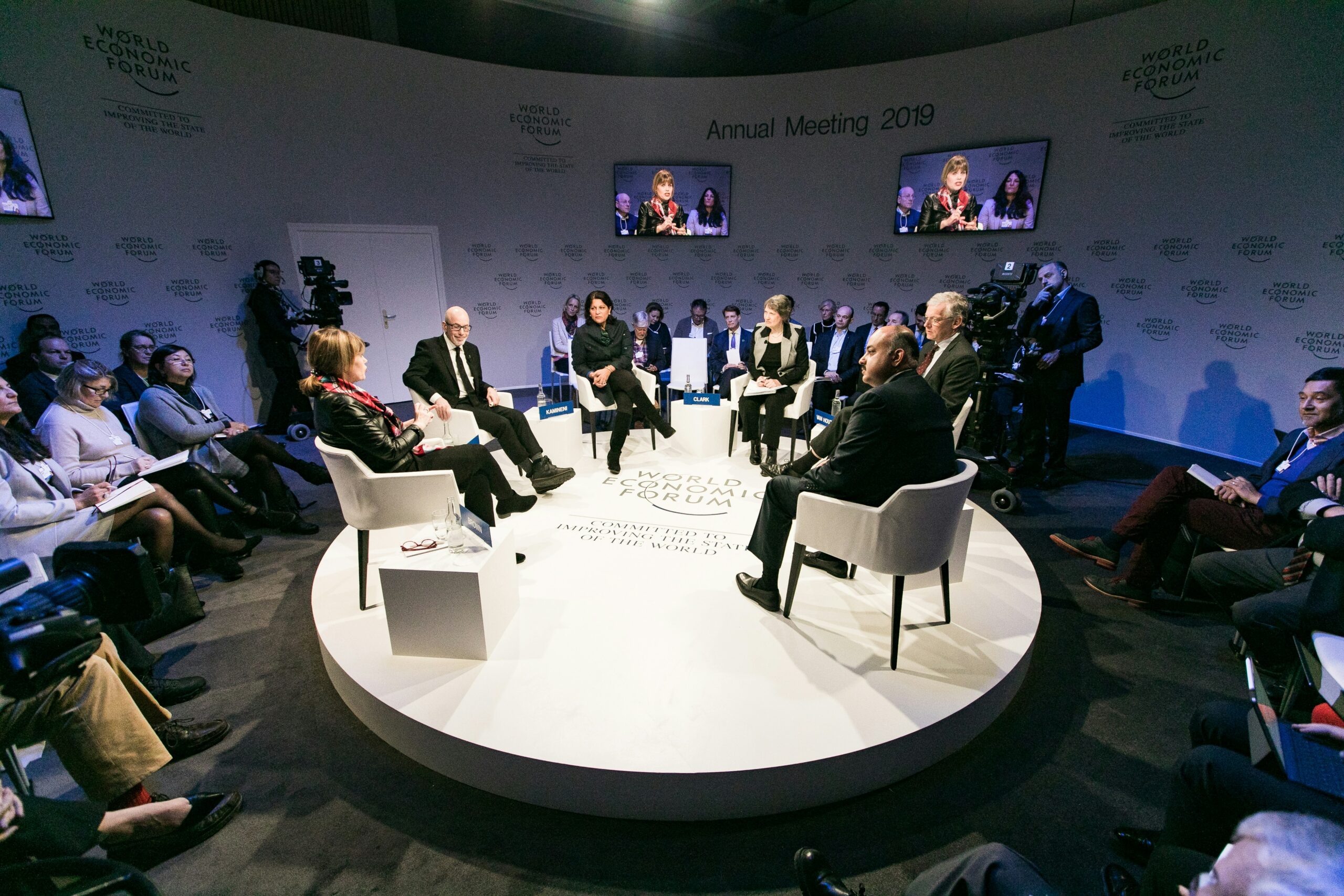
Theodore attended the World Economic Forum earlier this year, where the book was introduced. He came away with a more textured read on the state of global leadership than he expected. Two archetypes emerged clearly in those rooms: those invested in preserving continuity — protecting stability, capital flows, and institutional trust — and what he calls the agitators, those willing to question the architecture itself.
“Both roles matter,” he says. “Continuity prevents collapse and agitation prevents stagnation, which every system, from business to geopolitical diplomacy, is constantly fighting.”
He sides with the agitators, provisionally. “Every meaningful leap in political, economic, or technological history has required a destabilizing force first,” he says. What’s changed is the speed of visibility. “The difference today is that it unfolds in real time and is amplified and measured instantly through TikTok rather than carried slowly across centuries by printing presses. Visibility may be a new dimension of the equation, but the necessity for this change is not.”
“Growth should be the outcome of significance. Not a substitute for it.”
When asked what he wants CEOs to take from the book, he gives three answers that build on each other. Do more for others — not abstract stakeholders, but the actual people who buy from you and work for you. Do it for tomorrow: “If you keep optimizing only for today’s numbers, you will eventually run out of today’s to wake up to. Durability cannot be fallen into accidentally — it must be designed.” And test the model before you scale it: “If your model cannot hold up in a smaller, closer ecosystem, do not scale it. Fix the crack while it is still a crack. Because once scaled, that hairline fracture becomes a structural fault line.”
The final line he offers is the cleanest summary of everything the book is trying to do. “Growth should be the outcome of significance. Not a substitute for it.”
It sounds simple. The systems we’ve built make it very hard.
Built to Collapse is available now on Amazon. Eugene Theodore works with leadership teams, boards, and conferences on surfacing systemic risk and building toward enterprise durability.
Written in partnership with Tom White