
Organizations invest enormous energy in identifying high-potential leaders. Talent reviews are conducted. Succession plans are built. Leadership development programs are carefully designed to accelerate the careers of the people who appear most capable of carrying the organization forward.
And yet something puzzling keeps happening.
Many of the individuals who once looked like future stars eventually plateau. Their performance reviews remain strong. Their results are consistent. But their trajectory flattens. Their influence stops expanding. Instead of becoming the transformational leaders everyone expected, they become reliable contributors and stay there.
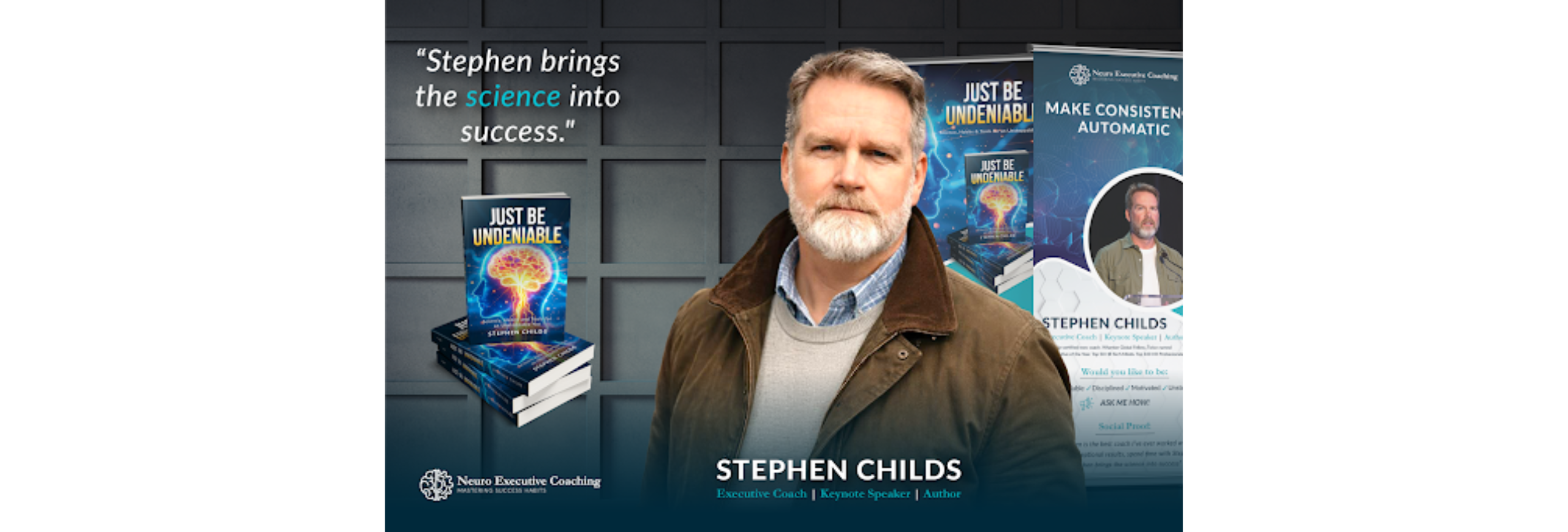
Stephen Childs has seen this pattern play out hundreds of times.
As one of North America’s most sought-after executive coaches and the author of the forthcoming leadership book Just Be Undeniable, Childs has spent two decades working with C-suite executives, emerging leaders, and high-performing professionals across multiple industries. And in that time, he has come to one consistent conclusion about why talented leaders stop growing.
“Leadership plateaus rarely occur because someone lacks intelligence, drive, or capability,” Childs explains. “More often, they occur because leaders stop evolving the habits, mindset, and behaviors that originally made them successful. Ironically, the very skills that helped them rise through the organization become the thing that quietly holds them back.”
When Competence Is No Longer Enough
Early in a career, success is largely driven by competence. Strong results get noticed. Exceptional work earns promotions. Demonstrating expertise is usually enough to open the next door.
But according to Childs, leadership changes the rules entirely.
“At higher levels of an organization, results still matter, but they are no longer the whole story,” he says. “Influence, presence, strategic communication, and the ability to lead across functions begin to matter just as much as the work itself. And most high-performing leaders are not prepared for that shift.”
Many talented leaders continue operating under the belief that exceptional work will naturally be recognized and rewarded. Childs argues this assumption is one of the most expensive mistakes a leader can make.
“The leaders who plateau are often doing excellent work,” he notes. “But they have failed to develop the behaviors required for the next stage of their career. They remain focused on execution when the role increasingly demands influence. They focus on analysis when the organization needs a strategic vision. They assume their impact is obvious when, in reality, many of the decision-makers around them never fully see what they are contributing.”
The Neuroscience Behind the Plateau
Childs grounds his coaching philosophy firmly in neuroscience, and the science offers a clear explanation for why plateaus form in the first place.
“The human brain is wired for efficiency,” Childs explains. “Once a behavior produces positive results, the brain wants to repeat it. Neural pathways strengthen through repetition, which is precisely how habits are formed. That process is incredibly powerful, but it also has a significant downside. The habits that create success at one level of a career can quietly become limitations at the next.”
This neurological reality is at the heart of Childs’ approach to executive development. In his book Just Be Undeniable, he makes a compelling case that sustainable leadership success rarely comes from bursts of inspiration or motivation. Instead, it comes from building small, repeatable behaviors that compound over time.
“Motivation is one of the least reliable drivers of long-term performance,” Childs says directly. “It fluctuates depending on stress, energy, and circumstances. Elite performers understand that motivation is not something you wait for. It is something you replace with systems.”
A Habit Problem, Not a Talent Problem
When Childs works with organizations experiencing leadership stagnation, his diagnosis is almost always the same.
“In most cases, a leadership plateau is not a talent problem,” he states. “It is a habit problem.”
Consider a technically brilliant leader who has spent years mastering financial analysis or operational strategy. Their expertise may be exceptional, but if they have never developed the habit of building cross-functional relationships, their influence will eventually stall. Or consider the leader whose work is outstanding, but who has never developed the habit of translating that work into visible strategic impact across the organization.
“These are not personality flaws,” Childs is quick to point out. “They are behavioral patterns. And behavioral patterns can absolutely be changed when someone is intentional about changing them.”
His prescription for organizations is equally direct. “Spend less time talking about potential and more time focusing on habit formation,” he advises. “Talent reviews identify who might become a great leader someday. But very few organizations intentionally build the daily behaviors that make leadership growth inevitable.”
The Rule of 100
One of the most powerful concepts Childs shares with the executives he coaches is what he calls the Rule of 100, a deceptively simple principle that he has seen transform careers at every level of an organization.
“If someone invests just 100 hours of focused effort into developing a specific skill over the course of a year, they will often become better than 95 percent of their peers in that area,” Childs explains. “At first glance, 100 hours sounds like a significant investment. In reality, it amounts to less than twenty minutes a day.”
The principle is rooted in the philosophy of marginal gains, the compounding power of consistent, incremental improvement. Applied to leadership development, Childs argues the results are transformational.
“Imagine what happens when a leader invests that level of focused practice into developing their executive presence, their communication, or their ability to influence at the enterprise level,” he says. “Over time, the compounding effect becomes unmistakable. The gap between that leader and their peers widens every single month, not because of dramatic effort, but because of consistent, deliberate practice.”
What Undeniable Leaders Do Differently
In Childs’ experience, the leaders who continue to rise inside organizations are rarely the ones with the most natural talent. They are the ones who remain the most intentional about evolving.
“They upgrade their habits,” he says. “They challenge their assumptions. They say yes to opportunities that stretch them beyond what feels comfortable. And most importantly, they understand that growth does not happen automatically. It happens when someone deliberately builds the mindset, systems, and behaviors that make success inevitable.”
That is the central idea behind Just Be Undeniable, the book Childs has written for every leader who knows they are capable of more and is ready to stop waiting for the right moment to prove it.
“Success rarely comes from waiting for opportunity or hoping someone notices your potential,” Childs says. “It comes from building the habits, the discipline, and the mental framework that make your impact impossible to ignore. Undeniable leaders never stop evolving. And the ones who understand that earliest in their career are the ones who go the furthest.”
Stephen A. Childs is an executive coach, CHRO, and the author of Just Be Undeniable, available now. Connect with Stephen on LinkedIn or visit StephenChilds.com to learn more about his coaching programs, masterclasses, and the Undeniable community.
Written in partnership with Tom White