
The age of artificial intelligence is not simply a technological shift—it is a leadership test. According to strategist and technology executive Alex Marroquín, the organizations that will shape the future are not necessarily the largest or most established, but the ones willing to experiment with bold ideas and rethink how strategy, technology, and human leadership intersect. “We are not being crazy enough,” he says.
For Marroquín, many companies approach artificial intelligence with the mindset of optimization: using AI to improve what already exists. Yet the true potential of this technological shift lies elsewhere.
AI is not simply about efficiency. It is about reinventing how organizations think, decide, and create value. And that kind of transformation requires something most corporations struggle with: bold thinking.
From Guatemala to Global Strategy
Born in Mixco, Guatemala, Marroquín’s journey to global boardrooms is far from conventional. He grew up in a modest household where his father worked as a technician and his mother as a seamstress. The challenges of his early environment—including exposure to violence and poverty—shaped a mindset centered on resilience and education as a path to transformation. Faced with the stark choice between joining the cycles of violence around him or pursuing a different future through learning, Marroquín chose the latter—an early decision that would ultimately define his trajectory.
That curiosity eventually took him beyond Guatemala, opening doors to academic opportunities, international work, and leadership roles across multinational organizations. Over time, he built a career spanning strategy, digital transformation, mergers and acquisitions, and emerging technologies.
Today, he is recognized as a corporate strategist who has spent more than two decades advising global companies and boards on digital transformation and emerging technologies. With academic exposure through institutions such as Harvard Business School and MIT, and experience working across innovation ecosystems like Silicon Valley and Cambridge’s Silicon Fen, Marroquín has positioned himself at the intersection of strategy, artificial intelligence, and global business transformation.
But Marroquín’s perspective on AI goes beyond technology. For him, the real question is not what artificial intelligence can do, but how leaders will choose to use it. “AI will not replace leaders,” he often argues. “But leaders who understand AI will replace those who don’t.”
The Courage to Think Differently
Marroquín believes that technological revolutions always reveal a deeper truth about leadership. When new technologies emerge, the biggest barrier is rarely technical knowledge. It is fear of thinking differently.
That is why he often challenges executives with a provocative idea: “If we want to lead in the AI era, we need to be a little more crazy.” The comment is less about risk and more about imagination.
For Marroquín, organizations that win in the AI age will not simply automate processes. They will redesign their industries. They will ask questions others are afraid to ask. And they will build teams capable of navigating uncertainty with curiosity instead of hesitation.
Rebuilding Strategy in the Age of AI
One of the areas where Marroquín is actively working is the transformation of supply chains through artificial intelligence. He is the Chief AI Officer of GRYDD, a platform focused on creating a new operating system for global supply chains.
GRYDD aims to make supply chains predictive, connected, and collaborative in real time, allowing organizations to move away from static planning models toward dynamic decision-making powered by data and AI. In a world where disruptions—from pandemics to geopolitical conflicts—have become the norm, platforms like GRYDD attempt to redesign the digital infrastructure that supports global commerce.
For Marroquín, this is precisely the kind of “crazy idea” leaders should be exploring: rethinking entire operating systems of business rather than simply optimizing existing processes.
Strategic Dialogue with Global Thinkers
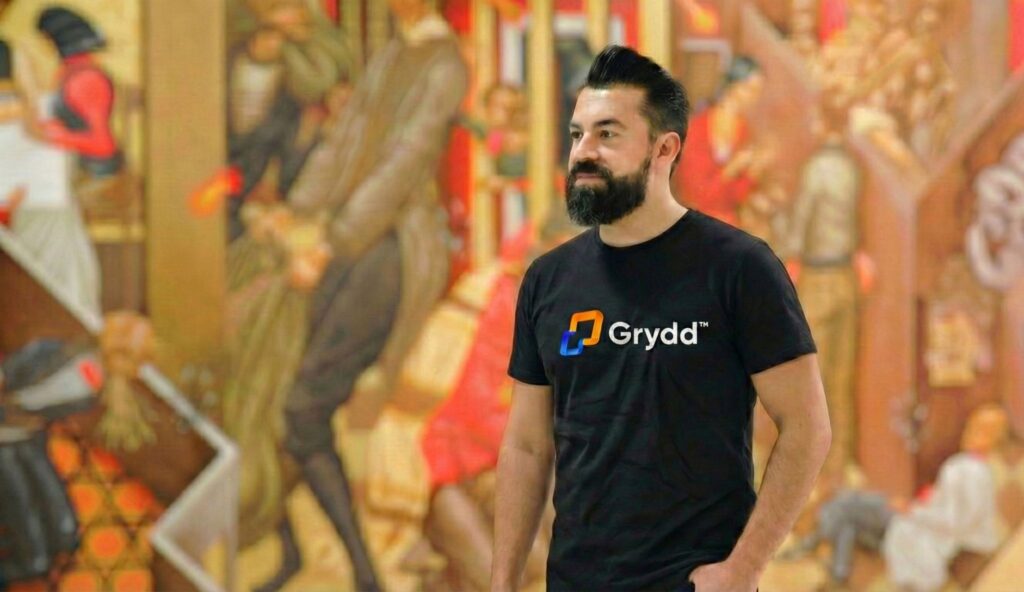
Another dimension of Marroquín’s work lies in collaborating with other strategic thinkers and advisors to shape conversations about technology and leadership. Among them is Glenn Tjon, an international strategist and board advisor recognized for helping organizations bridge generational perspectives in leadership and decision-making. His philosophy captures the mindset required in times of transformation: “Stay curious. Keep growing. Winning follows.”
Together, they are also involved in the Institute for the Acceleration of Artificial Intelligence (IA²), an initiative focused on helping organizations and executives understand the strategic implications of AI and accelerate its responsible adoption across industries. The institute serves as a platform where business leaders, technologists, and policymakers can explore how artificial intelligence is reshaping governance, corporate strategy, and global competitiveness.
Through conversations, joint initiatives, and intellectual exchange, figures like Marroquín and Tjon are helping frame a broader debate about what leadership looks like in an AI-driven economy. Their shared focus is not only on technology adoption, but on helping executives rethink governance, innovation, and long-term strategy in an increasingly complex world.
These discussions reflect a broader shift happening in boardrooms: artificial intelligence is no longer an IT issue—it is becoming a central strategic question.
Nesa Care: AI for Preventive Health
Marroquín is chairman of initiatives that demonstrate how artificial intelligence can impact sectors beyond traditional business operations. One example is Nesa Care, a health-tech platform focused on predictive medicine and preventive healthcare.
The platform uses AI-driven algorithms to identify risk factors for diseases such as breast cancer, colon cancer, thyroid cancer, diabetes, and depression through a rapid screening process that integrates clinical, hereditary, and population-level data.
Through a short questionnaire and predictive models trained on real population data, the system can identify potential health risks before symptoms appear and connect users with medical services for confirmation and treatment. This data also feeds into Nesa Lab, the initiative’s research laboratory, where insights are further developed to improve predictive models and advance preventive healthcare. The broader goal is to move healthcare systems from reactive treatment to proactive prevention, while also helping insurers and employers reduce healthcare costs and improve population health outcomes.
The initiative also incorporates social impact by allocating part of its revenue to support different nonprofit organizations in providing diagnostic testing and expanding access to preventive healthcare programs.
For Marroquín, projects like Nesa Care illustrate a key principle: AI becomes transformative when it moves from hype to real-world application.

The Kind of Leaders the AI Era Requires
If there is one message Alex Marroquín consistently delivers to executives and entrepreneurs, it is this: the future will not be built by cautious optimization. It will be built by leaders willing to experiment.
The companies that thrive in the coming decade will be those that combine technical understanding, strategic imagination, and the courage to rethink entire systems—from supply chains to healthcare ecosystems.
In Marroquín’s words, the AI era demands something many organizations still struggle to embrace: crazy ideas. The leaders who shape the future will not be the ones who slowly adapt to technology.
They will be the ones bold enough to redesign the world around it.
For Marroquín, artificial intelligence is not only about smarter tools. It is about a new generation of leadership—one capable of questioning assumptions, challenging legacy models, and building organizations designed for a future that is still being invented.And ultimately, in a world where machines will automate more and more tasks, the true competitive advantage will belong to those who become irreplaceable—leaders who combine creativity, judgment, and vision in ways no algorithm can replicate.
Written in partnership with Tom White